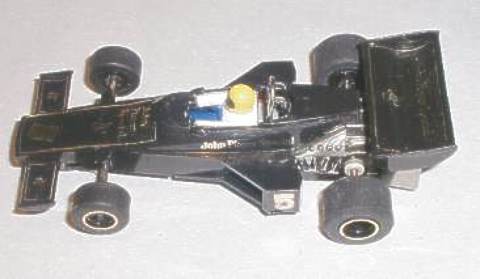
Scalextric Digital conversion of C126 Lotus 77

This Scalextric C126 Lotus 77 model was in very good working order and the owner wanted it brought up to date. Digital conversion, new Mabuchi motor, high grip tyres and a Neodymium magnet. These upgrades will give this car a new lease of life and more pleasure to the owner. Below is how we carried out the digital conversion and the other upgrades.
With the body removed the original Johnson 111 motor can be seen along with the simple wiring
These cars form the early 1970s were not that complicated.

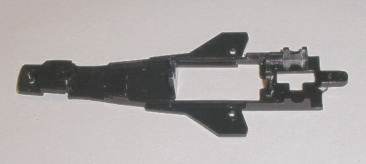
This is where we started. A completely bear chassis moulding. Now we can build the desired car.
Starting to build up the chassis with the new Mabuchi motor. Note the 2 adaptor pieces, one at each end of the motor. This gives the Mabuchi motor the same form factor as the Johnson 111 motor.
The adaptor at the rear of the motor has been shaped to mount the digital chip.
The 3mm hole has been drilled for the LED.
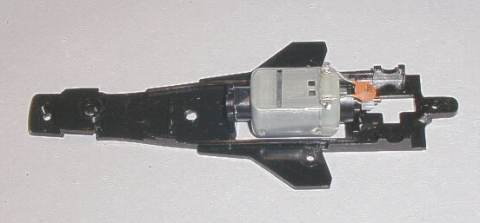

The lane changing LED is glued into position. We are using the C7005 In-Car Microprocessor manufactured by Scalextric.
The C7005 chip is for use with Formula 1 cars as it's smaller than the C7006 which is used for saloon cars.
The C7005 In-Car Microprocessor has been fitted into position and secured with adhesive to stop it moving around.
The LED wires are tucked in under the digital chip.


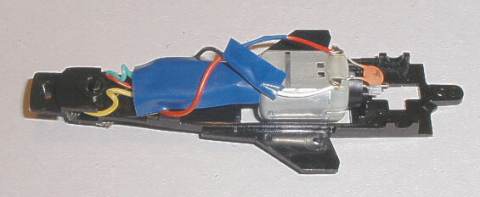
The wires that go to the motor from the C7005 In-Car Microprocessor are a little too short with the digital chip fitted where it is.
We added new wire to the motor to extend the original wires.
The wires to the motor were tailored in length, soldered together and protected with a piece of insulation tape.
A length of tape is also added to the digital chip to protect it from damage.
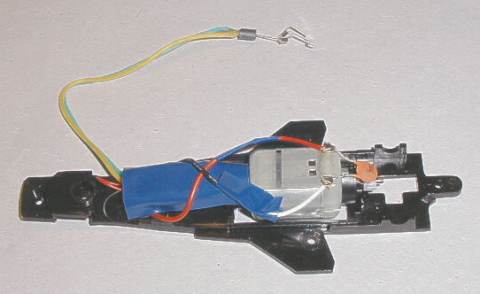
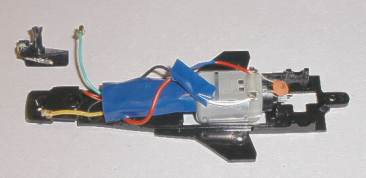
The original guide will be used so the wires from the digital chip are trimmed and terminated with the correct 1.95mm guide pins.
The guide pins were pushed into the guide moulding and the guide is refitted to the chassis.
The wires to the digital chip were looped to ensure there's no stress on the digital chip as the guide rotates.

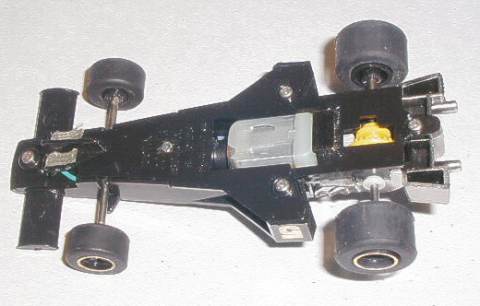
The original axles were fitted with new high grip tyres and then they were refitted to the chassis.
At this stage a D.C. functional test is carried out to confirm the electrical integrity of the digital chip installation. The C126 Lotus 77 model cannot be run on the track until the body is fitted.
The body and engine mouldings are fitted and the Neodymium magnet was fitted between the motor and the rear axle on the underside of the chassis. This gives the car lots of grip for acceleration and for cornering.
The magnet is secured with a drop of adhesive.

The car was tested on our Digital Test track. Everything worked as expected including the lane change LED. We also assessed the new motor, tyre grip and the effect of the Neodymium magnatraction magnet.
Each digitally converted car gets a thorough workout to ensure the car is as good as it can be.
With the rear wing fitted this car is complete and ready to be returned to it's owner. The car has had a new Mabuchi motor, new C7005 In-Car Microprocessor, new high grip superslix tyres and a Neodymium magnet fitted.
This car is now more like a modern Scalextric car and nothing like cars from the period.