Corroded,
oxidised and dull track rails
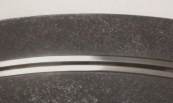
Over time and especially
if your Scalextric track is stored in a damp environment,
the steel rails of your Scalextric track can become discoloured
and slightly rough as the electroplated surface corrodes.
This slows down your Scalextric cars and wears out the Scalextric
car braids more quickly. In severe cases brown rust may be
present of the underlying steel rail.
To prevent this
simply polish the Scalextric track rails back to a smooth
clean surface with the track
polishing pads. These will do the job more quickly and
more effectively than any other method we know of.
There are three
grades of track polishing pad available, coarse, medium and
fine. The different grades are used for different purposes.
Coarse:
The coarse grade
pad is used to renovate track rails with rust marks and is
not intended for regular use. Use the fine grade pad or medium
grade pad after the coarse grade pad to complete the renovation
of your Scalextric track rails.
Medium:
The medium grade
pad is for use to renovate moderately tarnished track rails
and is not intended for regular use.
Fine:
The fine grade
pad is designed for regular use to remove dust, debris and
light tarnish from the track rails. It is also used after
the coarse grade polishing pad to give a smooth running surface.
Bent
or warped track pieces
Scalextric track
has a tendency to bend or warp over time. This may have
many causes among which are people stepping on the track
laid on the floor and perhaps the way that the classic track
clips together doesn't help.

Warped track
works well enough but can give your Scalextric cars a very
bumpy ride, especially down the long straight. Also, the
newer Scalextric cars will struggle as they are far more
likely to ground out on a bumpy Scalextric track layout.
The answer is
to shape the Scalextric track pieces back to level. To do
this simply reverse the bend in the track a little at a
time and a bend at a time until the track is visibly flat
again.
The most common
problem then is that the vertical sides of the steel track
rail bend outwards and block the slot in the track. This
is remedied by pushing the bulge back out of the way with
a flat blade screwdriver. There you have it, flat, level
Scalextric track that works for new
Scalextric cars as well as your older Scalextric cars.
Poor
electrical connections
An odd phenomenon
that can occur with a Scalextric track layout is that over
time part of the track layout looses power. The Scalextric
cars run great near to the track power base or where the
power is connected to the track but slow down away from
the power connection point.
This effect can
happen several weeks or even several months after a circuit
has been constructed and not usually right away. We are
not too sure of the exact mechanism that causes this but
we know it's the joints between the track pieces that introduce
a high resistance to electrical current.
There are 2 readily
used fixes for this problem with Scalextric tracks; one
is to regularly take up the track and relay it with the
track pieces in different locations, strange but true. The
second is to run a Scalextric track
power booster cable around the track and make connections
to the track every couple of meters or so.

If your Scalextric
track layout is permanent then you'll be best advised to
make an electrical connection to every track piece with
the Scalextric track power booster cable. The best type
of connection is a solder joint.
Dirty
and dusty track
The only form
of grip for a Scalextric car is between the 2 rear tyres
and the track surface. Grip provides the acceleration force,
deceleration force and the cornering force too. Physics
tells us that the amount of friction is proportional to
the amount of force pushing the surfaces together and the
friction between those surfaces.
Force = Friction
x Normal force
To give the most
grip the track surface has to be as clean as possible. So,
how do you keep your track dust free? The simplest way is
to wipe your Scalextric track over with a damp (NOT wet)
cloth and dry immediately. This will remove the dust and
debris and give you the best possible grip from your Scalextric
track. Ensure the track is dry before you go racing.
Compatibility
between different track types
Over the years
there have been several different types of Scalextric track
systems used. The earliest is the rubber track used in the
very early 1960s. This changed to the plastic track with
the round clips which remained in production until the early
2000s and is still very common today.
Currently there
is the modern Sport
track with it's straight clips and the Start track.
All four types of track are NOT compatible with each other.
The most common types are the current Sport track and the
classic track with the round clips. There is a Scalextric
converter track piece available to join these two track
systems together.

Building
your own track layout
Putting together
lots of Scalextric track pieces is a good way to build a
temporary or a semi permanent track layout. The choice of
interesting Scalextric track pieces is OK especially with
some of the digital options.
For a fully permanent
layout the limitations of using Scalextric track pieces
can be done away with by making your own slot layout. There
are only two things you need, the slot and the conductors.
After that, you can design what ever shape circuit you like.
The slot can
be cut into the base board using a router with a suitable
bit and for the conductors you can use self adhesive copper
tape. The copper tape is available on rolls with plenty
of length. The board can be painted to form the track, run
off areas, add height, infield and all sorts of props to
give your layout realism.
Finally, the
best benefit of this type of layout – the magnatraction
magnet doesn't work!!
How
best to resurrect your old Scalextric set